!!!!!

Science!!!!! :)

Wednesday, January 25, 2012

Reflection on Cracking the Code of Life Movie

          So far, this movie has taught me a lot about genetics, and since it's pretty interesting, what I learn sticks in my brain.  One really important thing that I learned from this movie is that even just one wrong letter in your DNA can decide whether you will grow up to have schizophrenia, a deathly disease, cancer, or some other horrible illness.  Just one out of all the millions of A's, C's, G's, and T's in your DNA can determine how your life will end.  One example of a rare but horrible disease that is caused by two parents passing two of the same recessive alleles to their child was showed in the movie.  One pair of parents each had the Tay-Sachs gene in their bodies.  Both of them passed this gene on into their child, and their child developed this disease.  The father's identical twin brother had just resolved that he had to be his brother's rock and support him, when he discovered that his child, too, had Tay-Sachs.  It was such a sad story because Tay-Sachs is such a rare disease.  Even if one parent has the allele for it, they won't be able to pass it on so that it harms their child, and if both parents have it, there is only a 25% chance of their kids getting the disease. 
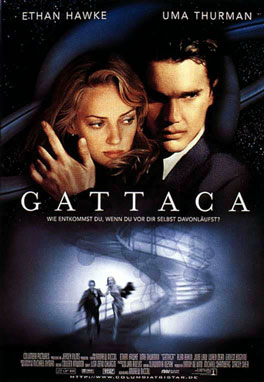
          The movie then discussed how scientists may be able to map one person's entire DNA, and tell them which diseases they may develop, how long they may live...everything about their future.  Personally, I think this is a great idea if you are only doing it to stop yourself from passing illnesses on to future generations.  However, I feel that if we have this ability to map out peoples' lives in our hands, our world will become kind of like the one in the movie GATTACA.  You will only be able to do a certain job because of the DNA you have, and you won't be allowed to do other things because of your genes.  I don't think that this would be such a great thing, and I hope that if our planet does become like GATTACA, it doesn't happen in my lifetime.

Saturday, January 21, 2012

Current Events: Twins and Heredity

          National Geographic is talking about studies on twins and how they can help scientists discover exactly how much of an influence heredity has on our lives.  One very interesting story featured in the article was about two twins who were separated at birth.  Coincidentally, both families who adopted each twin named their kids Jim.  The two twins were reunited when they were 39, and they realized that, even when they were separate, they had led similar lifestyles.  Both Jims had married and divorced women called Linda, and then remarried to women called Betty.  They had named their sons James Allan and James Alan, and they had both taken their families on vacation to the same beach in Florida.  Both men had had dogs named Toy, and each had been part-time sheriffs, dabbled in carpentry, smoked the same kinds of cigarettes, and drank the same kinds of beer.
          I thought that this section in the article was very interesting, because it helps show exactly what a strong pull genetics has in our lives.  When I read it, I was shocked that the two Jims even married wives with the same names.  How does liking different names have anything to do with genetics?  But how can it be a coincidence that so many of the names in the two Jims' lives were the same?  This article was also very thought provoking, because it also said that even though they had been raised in different families, both had similar IQ scores.  Later in the article, it stated that 75% of IQ differences was because of genes, and not the environment around the people.  I don't really like that idea, because they are trying to say that how smart you are depends on what you inherited from your parents.  I think that your surroundings and how hard you work also has an influence on your IQ, and I just don't really think it's fair that you inherit your smarts.

Resource:  National Geographic Magazine for January 2012, page 54

Mendel's Pea Experiment

         Gregor Mendel was a monk who lived in what we now know as Czech Republic.  He enjoyed gardening, and one day he became curious about the fact that some pea plants were tall and others were short; some were yellow, and some were green etc.  Mendel decided to check this out, so he forced a tall pea plant and a short pea plant to mate with each other by collecting the pollen from one and placing it in the pistil of the other.  He made sure that neither plant mated with its own type.  The pea plants produced from that experiment were tall - not of medium height like you would expect to get by mixing a tall and a short plant, but tall.  After many more experiments, Mendel then proceeded to mate the offspring of the original pea plants with each other.  Curiously, three out of four pea plants were tall, but one was short. 
          From these experiments, Mendel became the first investigator of genetics.  The parent plants were both purebred short and tall pea plants.  When they were mated to produce F1 offspring, each parent plant passed on one allele.  (An allele is a form of a gene that changes is in charge of changing only one aspect of a trait.)  The tall plant passed on an allele for being tall, and the short one passed on an allele for being short.  If the dominant or tall allele is represented by a capital T and the short or recessive allele is represented by a lowercase t, then the alleles for the F1 offspring looked like Tt.  What Mendel began to discover was that a recessive allele will only be visible in an organism if it is the only allele for that trait present.  If there is one tall and one short allele, then the plant will be tall.  If there are two tall alleles, then the plant will be tall.  The only way the plant will be tall is if it has two short alleles.  This is why none of the F1 offspring were able to be short, because they always had one short and one tall allele.  However, when Mendel mated F1 offspring with each other to make F2 offspring, he noticed something strange:  approximately 1 in every 4 pea plants created by two F1 offspring were short.  This was because, although all the F1 offspring were tall, they each had one short and one tall allele.  When two of them were mated, there was a small possibility that, out of Tt and Tt alleles, a seed would be generated that would be tt. 
          The experiment we did was that we had a bowl full of yellow and black balls to represent peas.  The ratio of yellow to black peas was uneven, and there were many more yellow peas than black ones.  We took turns pulling out four "peas" from the bowl and recorded our data.  We did this 20 times.  Each time, we wrote down how many yellow and how many black balls we pulled out of the bowl, and then we averaged our results.  In the end, we pulled out 2.85 yellow peas and 1.15 black peas, which averages down to three yellow and one black pea.  Mendel, on the other hand, would have had to do this experiment MANY more times, since he did not know any of the things we do now about genetics.  Mendel probably had to plant 50 to 100 pea plants to be sure of his data.

Thursday, January 12, 2012

Reflection on Gattaca

          I really enjoyed this movie.  I thought that it was really interesting how everyone was chemically made to be immune to diseases, live long lives, and have overall good bodies physically.  Also, scientists were able to get rid of traits such as attention deficit disorders and anger management problems.  However, I thought it was really unfair that people who didn't have great genes were not allowed to do things like fly into space, but that others who were genetically modified could take good jobs just by giving in a urine sample.  Even if someone had a really good brain, they would not be permitted to do the really important stuff.  If you had not been made in a test tube, then you were not expected to be great physically, either.  No matter how hard you trained, everyone would expect you to lose in sports because of your genes.  I also thought that it was really interesting that scientists were able to figure out one person's whole life at birth.  The main character was told that he had a 99% chance of heart problems, an expected life span of 30.2 years, and many other things the second after he was born.  From then on, people could tell everything about you just by taking a urine, hair, blood, or skin sample from your body.  This whole idea of genetics and DNA was very, very interesting and overall, I enjoyed the movie.  Even though it's fictional, I learned a lot about how DNA is almost everything about you from the film.

Monday, December 12, 2011

Science Essay: Acid Rain

          Acid rain is yet another form of pollution.  Caused by burning coal, driving cars, erupting volcanoes, and other means – both natural and man-made, acid rain can cause serious harm to the animals and people around it.  Acid rain is caused by an excess of nitric and sulfuric acids in the atmosphere.  When it falls down in the form of rain, or is combined with dust, it affects the environment around it in negative ways.  When you add acid to ponds and lakes, aquatic life is put into danger.  Fish die out and those that eat them must starve.  When acid lands in soil, many plants cannot survive, and herbivores do not have enough food.  The effects of acid rain snowball out of control, like a wave of dominoes.  Acid rain can destroy a whole way of living for the animals living in one area.  However, many scientists are trying to figure out ways of preventing this big problem.  Acid rain is an issue we must all try to change. 
When gasses such as carbon dioxide, carbon monoxide, and substances like lead and other air pollutants are released into the atmosphere, acid rain is produced.  Acid rain is the product of this pollution: an excess of nitric and sulfuric acids is spread over large areas of land through rain (in wet places) and dust (in dry places).  There are many reasons why acid rain is caused – both man-made and natural.  Erupting volcanoes and rotting plants can cause the toxic gasses to go up into the atmosphere, but the majority of acid rain is caused by humans.  When we drive cars and ride in planes and trains and boats, we release carbon dioxide and other dangerous substances into the air.  Acid rain can fall in two categories: wet deposition and dry deposition.  Wet deposition occurs when acidic chemicals are blown into wet areas, which results in acidic water.  Dry deposition happens in very dry areas, where there isn’t very much rain.  The acid chemicals end up being distributed in dust and dirt, instead of water.  Both of these ways of releasing acid rain into the environment are very harmful for people and animals. 
            Acid rain can affect both humans and animals, but it is most dangerous towards aquatic life.  As acidic water flows downhill, it deposits aluminum in nearby streams, rivers, and lakes.  When it settles in a lake, the pH of that lake goes down, becoming more and more acidic.  This means that even as more acid is being added to underwater ecosystems, toxic aluminum is being deposited there as well.  Many fish and other marine animals cannot survive in areas of low pH.  At a pH of five, most fish eggs will find it impossible to hatch, and at any pH lower than five, many more adult fish will die.  Some animals, such as frogs, have developed a tolerance toward acid.  However, the insects they depend on for food may not be able to withstand water with a low pH.  So even if a particular species can survive in acidic conditions, the prey they catch cannot, so they will die anyway.  Not only is the livelihood of frogs and fish damaged, but birds are affected, too.  Snails find it difficult to survive in areas of high acidity, because they depend on calcium found in soil.  Much of this mineral is lost when it is replaced by acid.  If snails don’t find enough calcium in their habitat, they cannot survive, and die out.  This causes a problem for the birds.  Snails are a high source of calcium, and eating them helps birds to lay strong eggs.  When there aren’t enough snails for birds to eat, then the eggs, the birds can’t get enough calcium in their systems, and they are forced to lay eggs with very thin shells.  Many eggs are unable to hatch because of shell breakage and other accidents.  If the population of birds is depleted, then there is less food for predators who depend on birds to eat.  This, in turn, affects the carnivore population.  It is one big chain reaction. 
            There are many good things being done to help reduce the amount of acid rain produced by factories and cars.   According to the website epa.gov, instruments such as catalytic converters help reduce the amount of harmful gasses released into the atmosphere when we drive.  Also, “scrubbers” are used to reduce the amount of nitric acids that escape from factory smokestacks.  Not only can we try to reduce the amount of nitric and sulfuric acids we produce, but we can also attempt to prevent them from reaching the air.  We can do this by using alternative energy sources such as solar, wind, and hydroelectric power.  These are examples of “green” energy sources, and they have very minimal negative impacts on the environment.
            Acid rain is a serious issue that we all need to be aware about.  It is an overdose of nitric and sulfuric acids in the atmosphere that become absorbed into the natural environment.  It is caused by cars, factories, and other sources that produce exhaust.  Acid rain affects the natural habitats of animals and people around it in very negative ways, and can damage a whole way of living in an ecosystem.  Fortunately, scientists are learning how they can help prevent the spread of acid rain, and, in doing so, help our environment.  

Works Cited
“Acid Rain.” Protecting the Home we Live in:  Environmental Issues. Novi Meadows Elementary, 2002. Web. 28 Nov. 2011. <http://library.thinkquest.org/‌CR0215471/‌acid_rain.htm>.
“Acid Rain.” US Environmental Protection Agency. US EPA, 24 Mar. 2011. Web. 28 Nov. 2011. <http://www.epa.gov/‌acidrain/‌index.html>.
“Acid Rain/‌Prevention.” PB Works. PB Works, 2007. Web. 6 Dec. 2011. <http://acidrain.pbworks.com/‌w/‌page/‌1319114/‌Prevention>.


Tuesday, November 22, 2011

Burning Paper Lab

Science Paper Lab

Research Question:  How does changing the state of paper affect how fast it burns?

Background Information:  The reaction we are creating is a chemical reaction involving turning paper into ash.  This cannot be reversed, so it is a chemical reaction.  

Hypothesis:
Riena:  I think that if we use paper that has been wet and then dried, it will burn the longest.  This is because remnants of water may still remain in paper.  The more wet a piece of paper is, the longer it will take to burn.  

Variables:
    -Independent Variable:  This is the variable that we change.  In this experiment, it will be the state of the paper we burn that is the dependent variable.
    -Dependent Variable:  This is the variable that is the response of what happens to the independent variable.  In this case, the dependent variable is the time it takes for each paper to burn.  
    -Controlled Variable:  The controlled variable is one that stays the same throughout the experiment. It does not change and is not allowed to change unpredictably.

Safety Cautions:
-While burning the paper, make sure that you burn it in a fire-safe container
-Be careful that none of the fire escapes from the container
-Do not let anyone touch the paper while  it is burning
-Do not get too close to the paper while it is burning
-You may want to wear goggles to protect your eyes, although these are not vital to the experiment

List of Materials:
-Four sheets of A4 paper
-Matches
-Something to burn the paper in
-Writing Materials
-Stopwatch

Procedure:
1.) Burn a regular piece of paper
2.) Record observations*
3.) Crumple up that piece of paper the same size as the first, and burn it
4.) Record observations
5.) Wet another piece of paper, let it dry, crumple it up, and burn it.
6.) Record observations
7.) Wet another paper, let it dry, and then burn it.
8.) Record observations

*Fill out all observations in data table below


Data Table:
State of Paper:Time it Takes to Burn (seconds): Other Observations:
Regular 78Had to re-light
Wet and Dried 31Much wind
Crumpled 67
Crumpled, Wet and Dried 105

Graph


Conclusion: 
          My hypothesis was correct.  The "crumpled, wet and dried" paper took the longest to burn by a long shot.  As you can see in both the graph and table above, the paper that we soaked in water, dried, and crumpled up took 105 seconds to burn, whereas the paper that burned the second slowest took 78 seconds to burn.  The "wet and dried" paper might also have taken a longer time to burn, but while we were burning it, a gust of wind hit us.  This meant that there was more oxygen, and therefore more fuel, which meant that the paper burned more quickly. 

Further Inquiry:
          While we were conducting the experiment, many things went wrong.  There was an inconsistent amount of wind, and we had to re-light some of the papers.  The amount of wind in an experiment matters because wind affects how much oxygen is present.  Oxygen fuels fire: the more oxygen, the greater the fire.  Also, too much wind will blow out a small fire, and then we have to re-light the paper.  One of the fires went out, so we had to relight the paper, which took time.  This would have made us collect incorrect data.  If we were to do this experiment again, we should light our papers on a wind-less day.  This means we would not have wind, and our experiment would be unaffected.  If we wanted to collect even more information, we could measure the mass of each paper before and after we soaked them in water and dried them.  If we did that, we could see if paper gains mass after being soaked in water. 

Monday, November 7, 2011

Color Experiment

         In science class, we conducted a lab to figure out whether or not food coloring from skittles was polar or non-polar, and whether or not food coloring has more than one color in it at a time.  The way we did this was we dropped some water on different colored skittles to get the color out.  Then, we dabbed the color onto coffee filter paper.  After that, we put the paper in water.  Water traveled up the paper, and the idea was to see if the colors would travel up, too.  Since water is polar, and polar substances wash polar substances, if the colors rose, then they would be polar.  The coffee filter paper is non-polar, and since non-polar sticks to non-polar, we knew that if the color stayed, it was non-polar.  Also, if there were many different colors in one dye, they should have risen so that there was one color on top of another.  As you can see in the picture above, the experiment was done properly, and you can see that there are multiple colors.  The colors that rise the most, will be the most polar, as they will have traveled the furthest with the water.  The colors at the bottom near their dots are not as polar, because they have not followed the water up so far. 
As you can see in the picture to the left, we started out by putting the color on the dots.  However, we could not get enough dye to go on, or it was too diluted by water, so the colors are not very clear. 

In the photo to the right, you can see that the water traveled up the paper, but there is not very much color visible that has traveled up from the dots.  We did this experiment wrong, because we didn't put enough color on the paper, so it kind of failed.  We can't see anything going up the paper.  If we were to try this lab again, we should add more skittle dye to the paper, and we might want to use white paper instead of brown so that the color would show more.